• Re: Is it possible .....??

    From Daniel70@daniel47@nomail.afraid.org to alt.os.linux,alt.comp.os.windows-11 on Sat Mar 7 20:53:50 2026
    From Newsgroup: alt.os.linux

    On 7/03/2026 6:06 am, rbowman wrote:
    On Fri, 6 Mar 2026 22:03:49 +1100, Daniel70 wrote:
    On 6/03/2026 9:35 pm, Carlos E.R. wrote:
    On 2026-03-06 10:00, Daniel70 wrote:
    On 5/03/2026 11:33 pm, Jasen Betts wrote:

    <Snip>

    There were computers before UNIX, and languages before C

    Oh, sure, there were computers back in WWII-times .... just I've never >>>> considered them in more widespread than Defence-type usage.

    66 is not WWII times. It is the times of the Apolo missions,

    Of course!! Of course!!

    Gee Whiz. I just hate it when someone shoots me down in flames ....
    soooo easily!!

    My first programming class was in '66, FORTRAN IV on an IBM System
    360/30. There were a few schools like Dartmouth that had started
    fledgling CS programs but this wasn't seen as a career path, only another tool to be used like our slide rules. There was also an analog computer
    lab just in case. Except in niche applications analog was on the way out.

    Good things never die and analog is showing some promise in neuromorphic applications. After all the brain is an electrochemical analog device.

    As I think I've mentioned elsewhere, I did my Electronics Apprenticeship
    in the Aust Army 1973 -75. If, at the end of that three year period, we
    had passed all our Trade Modules (Discrete Components all the way up to Transistors and Valves)/General Education Subjects/Military
    Training/Physical Training Assessments, there was a two Week period
    where we were given an Introduction to Integrated Circuits .... And/Or/Nand/Nor ... up to four gates per IC!!

    High Teck!!

    As for Eliza, there were CP/M versions running on 8080 and Z80 machines in the late '70s.

    Studied 8085/Z80/6809 programming 1989 --> 1991.
    --
    Daniel70
    --- Synchronet 3.21d-Linux NewsLink 1.2
  • From rbowman@bowman@montana.com to alt.os.linux,alt.comp.os.windows-11 on Sat Mar 7 19:25:18 2026
    From Newsgroup: alt.os.linux

    On Fri, 6 Mar 2026 22:40:12 +0100, Carlos E.R. wrote:

    Once I built a 1 bit adder with relays, just for fun. Nobody appreciated
    the fun, the IBM PC clone era was in full blast.


    https://codehiddenlanguage.com/Chapter08/ https://codehiddenlanguage.com/Chapter14/

    Note that the pages are interactive. In chapter 8 he relates relay
    circuits to the logic symbols. In the text he says you could build an
    adder with relays -- a lot of relays.

    It's an interesting book by Charles Petzhold who wrote many Windows programming books. It reads like it was written for young adults but some
    of the concepts get pretty deep.
    --- Synchronet 3.21d-Linux NewsLink 1.2
  • From rbowman@bowman@montana.com to alt.os.linux,alt.comp.os.windows-11 on Sat Mar 7 19:57:36 2026
    From Newsgroup: alt.os.linux

    On Sat, 7 Mar 2026 02:02:29 -0500, Paul wrote:

    Now that's something I've not tried, is using relays for logic.

    That means you must be an expert at designing snubbers then

    You should have gone for broke, and done a 4 bit adder.
    Then your next step would be a calculator made out of relays.

    See my other post in the thread about Petzholt's 'Code' and his
    interactive website.

    https://www.allaboutcircuits.com/worksheets/electromechanical-relay-logic/

    The circuits could get complex with inputs from pushbuttons, limit
    switches, electro-mechanical timers, and other hardware. You were building
    a state machine with 120 VAC components.

    Solid state slowly entered the industrial field. Square D, a major
    supplier of switchgear, came out with NORPAK. There was an assortment of modules and back planes to mount them in. Programming was done with wire jumpers similar to the Dupont wires used with solderless breadboards. They were more secure since you used something like a automatic center punch to
    set the taper pin.

    The problem was the NOR gate is the easiest to create with transistors.
    Try designing logic when all you have is NORs and inverters. You start
    talking to yourself.

    Next up was the programmable logic controller (PLC) which is used to this
    day. I never worked with them as I'd moved on to straight 8080/Z80 controllers.

    At the time the interface used the metaphor of relay based ladder diagrams that was understood by industrial electricians. I was surprised when I interviewed a candidate who had experience with PLCs and he said ladder diagrams are still the most popular interface.

    Logic is logic. We built plastics molding systems and the hydraulic
    circuitry also implements logic with spool valves, check valves, and so
    forth. Air logic is the same. I've used that for explosive environments
    when you don't want sparks.

    https://fluidpowerjournal.com/design-efficient-air-logic-system/


    Fluidics is similar but can work with no moving parts at all.

    https://en.wikipedia.org/wiki/Fluidics

    It's all logic.

    https://en.wikipedia.org/wiki/Z3_(computer)


    --- Synchronet 3.21d-Linux NewsLink 1.2
  • From rbowman@bowman@montana.com to alt.os.linux,alt.comp.os.windows-11 on Sat Mar 7 20:03:13 2026
    From Newsgroup: alt.os.linux

    On Sat, 7 Mar 2026 20:53:50 +1100, Daniel70 wrote:

    Studied 8085/Z80/6809 programming 1989 --> 1991.

    Kids! THe 8080 came out in '74 followed by the Z80 in '76. I mostly
    worked with Z80s. It had a couple of extra instructions but was otherwise
    the same. Of course Intel had a patent on the assembler so Zilog had to do
    it differently.

    --- Synchronet 3.21d-Linux NewsLink 1.2
  • From Carlos E.R.@robin_listas@es.invalid to alt.os.linux,alt.comp.os.windows-11 on Sat Mar 7 22:04:28 2026
    From Newsgroup: alt.os.linux

    On 2026-03-07 08:02, Paul wrote:
    On Fri, 3/6/2026 4:40 PM, Carlos E.R. wrote:
    On 2026-03-06 20:11, rbowman wrote:
    On Fri, 06 Mar 2026 11:09:54 -0500, Tim Slattery wrote:

    "Carlos E.R." <robin_listas@es.invalid> wrote:

      Defence-type usage.

    66 is not WWII times. It is the times of the Apollo missions, which had >>>>> flight computers. Computers did exist, although huge. Early 70s, there >>>>> was a computer room at my father's job. Programmers tried things to find >>>>> out what could be done with a computer.

    I was in Palo Alto (California) High School at that time. The high
    school was right next to the School District offices, so I was able to >>>> take a computer programming course. We were able to use the school
    district's IBM1620 to run our programs. A small (for the time) machine, >>>> and not very powerful, but it got me into programming. IBM 360s and 370s >>>> were also around at that time, and many governments and companies used >>>> them. Micro computers that you could own yourself debuted in the 1970s. >>>
    While I learned FORTRAN IV in the mid-60s I didn't have much interest in >>> programming until the '70s. I'd worked with industrial control circuitry, >>> all relay logic, that slowly went solid state, and ultimately to MCUs. One >>> 8080 could replace a LOT of octal base relays. Logic is logic.

    Once I built a 1 bit adder with relays, just for fun. Nobody appreciated the fun, the IBM PC clone era was in full blast.


    Now that's something I've not tried, is using relays for logic.

    That means you must be an expert at designing snubbers then :-)

    Oh, not a problem at all on that board. I just used a single breadboard, small, and relays that could be inserted directly there, kind of
    miniatures. And LEDs for lights.


    You should have gone for broke, and done a 4 bit adder.
    Then your next step would be a calculator made out
    of relays.

    I wanted to, but did not have that many relays.

    I lost the schematic, I don't remember how I did it. I emulated xor
    gates, I think.


    We had a guy at work, who liked to design asynchronous
    logic. His circuits always ran faster than everyone
    elses (because... they didn't wait for a clock edge).

    Right!

    But designing those (without computer assistance), is
    a lot of work. As you need cover terms so stuff does
    not glitch. There were even commercial companies
    interested in the idea, but it kinda died out. At least
    he didn't break anything. I could trust him not to
    blow up a project. He wasn't a kook.

    *******

    Some engineers are known for their weird fixations with components.
    My manager hired a guy, he was mostly non-communicative. I couldn't
    say there was a language barrier, as we never had any conversations
    with him.

    He was given a specification to work with, and he went off to design it. Months went by, he was wire wrapping it in the lab and so on. Well,
    nobody pokes around someone elses design (unless it is design review
    time). And being non-communicative, he wasn't partnered with anyone,
    he didn't ask any questions and so on. In other words, no one at
    all was able to learn anything about exactly what he was doing.

    So one day, he tells the manager it is finished and it is running
    in the lab. The proof it is working, is one red LED. If the LED
    is lit, it's working. If the LED is off, it's not working. (This is
    a bunch of status circuitry, monitoring logic operation.) Well,
    the thing was built entirely out of hex packs of transistors.
    All the gates (it's a digital logic function) were made from transistors. There was no jelly bean logic on the board. There must have been
    hundreds and hundreds of transistors. Then the guy says "he's leaving"
    and he is gone, just like that. We never heard from the manager, exactly what he thought of this :-) But, another lesson learned about
    handling people.

    !!


    If you're going to make a fetish about designing with relays,
    don't tell anyone :-) And pretend to be non-communicative
    while you're building your contraption. Seems a good strategy.

    LOL :-D
    --
    Cheers, Carlos.
    ES🇪🇸, EU🇪🇺;
    --- Synchronet 3.21d-Linux NewsLink 1.2
  • From Carlos E.R.@robin_listas@es.invalid to alt.os.linux,alt.comp.os.windows-11 on Sat Mar 7 22:09:08 2026
    From Newsgroup: alt.os.linux

    On 2026-03-07 20:57, rbowman wrote:
    On Sat, 7 Mar 2026 02:02:29 -0500, Paul wrote:

    Now that's something I've not tried, is using relays for logic.

    That means you must be an expert at designing snubbers then

    You should have gone for broke, and done a 4 bit adder.
    Then your next step would be a calculator made out of relays.

    See my other post in the thread about Petzholt's 'Code' and his
    interactive website.

    https://www.allaboutcircuits.com/worksheets/electromechanical-relay-logic/

    The circuits could get complex with inputs from pushbuttons, limit
    switches, electro-mechanical timers, and other hardware. You were building
    a state machine with 120 VAC components.

    Solid state slowly entered the industrial field. Square D, a major
    supplier of switchgear, came out with NORPAK. There was an assortment of modules and back planes to mount them in. Programming was done with wire jumpers similar to the Dupont wires used with solderless breadboards. They were more secure since you used something like a automatic center punch to set the taper pin.

    The problem was the NOR gate is the easiest to create with transistors.
    Try designing logic when all you have is NORs and inverters. You start talking to yourself.

    Next up was the programmable logic controller (PLC) which is used to this day. I never worked with them as I'd moved on to straight 8080/Z80 controllers.

    I had a training course with them. Beautiful things.


    At the time the interface used the metaphor of relay based ladder diagrams that was understood by industrial electricians. I was surprised when I interviewed a candidate who had experience with PLCs and he said ladder diagrams are still the most popular interface.

    Yes, it is curious.


    Logic is logic. We built plastics molding systems and the hydraulic
    circuitry also implements logic with spool valves, check valves, and so forth. Air logic is the same. I've used that for explosive environments
    when you don't want sparks.

    https://fluidpowerjournal.com/design-efficient-air-logic-system/


    At the PCC course I took, the first day we build a machine with
    compressed air, valves and pistons, to see the idea.


    Fluidics is similar but can work with no moving parts at all.

    https://en.wikipedia.org/wiki/Fluidics

    It's all logic.

    https://en.wikipedia.org/wiki/Z3_(computer)


    --
    Cheers, Carlos.
    ES🇪🇸, EU🇪🇺;
    --- Synchronet 3.21d-Linux NewsLink 1.2
  • From Carlos E.R.@robin_listas@es.invalid to alt.os.linux,alt.comp.os.windows-11 on Sat Mar 7 22:13:48 2026
    From Newsgroup: alt.os.linux

    On 2026-03-07 20:25, rbowman wrote:
    On Fri, 6 Mar 2026 22:40:12 +0100, Carlos E.R. wrote:

    Once I built a 1 bit adder with relays, just for fun. Nobody appreciated
    the fun, the IBM PC clone era was in full blast.


    https://codehiddenlanguage.com/Chapter08/ https://codehiddenlanguage.com/Chapter14/

    Note that the pages are interactive. In chapter 8 he relates relay
    circuits to the logic symbols. In the text he says you could build an
    adder with relays -- a lot of relays.

    Interesting!


    It's an interesting book by Charles Petzhold who wrote many Windows programming books. It reads like it was written for young adults but some
    of the concepts get pretty deep.

    I remember that name.
    --
    Cheers, Carlos.
    ES🇪🇸, EU🇪🇺;
    --- Synchronet 3.21d-Linux NewsLink 1.2
  • From Daniel70@daniel47@nomail.afraid.org to alt.os.linux,alt.comp.os.windows-11 on Mon Mar 9 21:26:29 2026
    From Newsgroup: alt.os.linux

    On 8/03/2026 7:03 am, rbowman wrote:
    On Sat, 7 Mar 2026 20:53:50 +1100, Daniel70 wrote:

    Studied 8085/Z80/6809 programming 1989 --> 1991.

    Kids! THe 8080 came out in '74 followed by the Z80 in '76. I mostly
    worked with Z80s.

    In 1989, I knew I would be going on Full Time Schooling to get my
    Associate Diploma of Engineering (Electronics) as it was required for
    further promotion with-in The Royal Australian Corps of Signals with-in
    the Australian Army and I knew one of the subjects taught would be Micro-Processors (6809), so I thought I'd get a head start, in 1989, by
    doing the 8085 subject at night school.

    Oww! Oww! I told a lie!! ;-P Read On.

    Then, after I got out of the Army (1993), I did some relief, fill in,
    teaching and THEN was told I'd be teaching the Z80 to the next
    generation of Army Apprentice!!

    It had a couple of extra instructions but was otherwise the same.

    "had a couple of extra instructions"!! Off the top of my head, an 8085
    had, was it, 256 instructions (8 bit Op Code??) whereas the Z80 had 510
    (8 bit Op Code??) instructions (255 basic Op Codes plus a
    secondary/Alternate set of 255 Op Codes).

    The 256th OP Code told the System that the Byte what follows was an
    Alternate Set Op Code.

    Of course Intel had a patent on the assembler so Zilog had to do it differently.

    Strangely, I thought Intel released the patents/designs-works for the 8085/8086/80186/80286/80386/80486 to every manufacturer that wanted it
    so that 'they' could wipe out Apples uProcessors ..... and then, with
    their Aim effectively achieved, Intel shut the gates so everyone HAD to
    buy their uProcessors from Intel.

    That led AMD and others to develop their own 586's/686's, etc!!

    Or something like that!!
    --
    Daniel70
    --- Synchronet 3.21d-Linux NewsLink 1.2
  • From Daniel70@daniel47@nomail.afraid.org to alt.os.linux,alt.comp.os.windows-11 on Mon Mar 23 20:12:38 2026
    From Newsgroup: alt.os.linux

    On 7/03/2026 5:51 am, rbowman wrote:
    On Fri, 6 Mar 2026 20:00:44 +1100, Daniel70 wrote:
    On 5/03/2026 11:33 pm, Jasen Betts wrote:
    On 2026-03-05, Daniel70 <daniel47@nomail.afraid.org> wrote:
    On 5/03/2026 7:25 am, Paul wrote:
    On Wed, 3/4/2026 6:12 AM, Daniel70 wrote:
    On 4/03/2026 8:24 pm, wasbit wrote:
    On 03/03/2026 12:52, Daniel70 wrote:
    snip < Thank you, Paul. I think I prefer HI (Human Intelligence) >>>>>>>> rather than AI (Artificial Intelligence). ;-P

    AI stands for Artificial Insemination. You can't Artificial
    Intelligence a cow! :)

    AH!! Of course. Is that why people now speak of "LLM" instead??

    They use LLM-AI to signify "this is not the final or real one".

    An AI that achieves Artificial General Intelligence (AGI) is the one >>>>> that will join the "exclusive AI club".

    The first AI I ran into, was a port of ELIZA.

    https://en.wikipedia.org/wiki/ELIZA

    Initial release 1966

    1966?? You have GOT to be joking!! 1996, yeah, maybe, but 1966, No
    Way!!

    '66? Sounds legit.

    There were computers before UNIX, and languages before C

    Oh, sure, there were computers back in WWII-times .... just I've never
    considered them in more widespread than Defence-type usage.

    https://en.wikipedia.org/wiki/Z3_(computer)

    WOW!! 1938/41!! Who'd of thunk??

    I wonder if the little desktop Zuse (Apple 2 clone) that I used in
    1983/4 might have been a great-great-grandchild of that big one??
    --
    Daniel70
    --- Synchronet 3.21f-Linux NewsLink 1.2
  • From =?UTF-8?B?Li4ud8Khw7HCp8KxwqTDsQ==?=@winstonmvp@gmail.com to alt.os.linux,alt.comp.os.windows-11 on Mon Mar 23 13:12:54 2026
    From Newsgroup: alt.os.linux

    On 3/23/2026 2:12 AM, Daniel70 wrote:
    On 7/03/2026 5:51 am, rbowman wrote:
    On Fri, 6 Mar 2026 20:00:44 +1100, Daniel70 wrote:
    On 5/03/2026 11:33 pm, Jasen Betts wrote:
    On 2026-03-05, Daniel70 <daniel47@nomail.afraid.org> wrote:
    On 5/03/2026 7:25 am, Paul wrote:
    On Wed, 3/4/2026 6:12 AM, Daniel70 wrote:
    On 4/03/2026 8:24 pm, wasbit wrote:
    On 03/03/2026 12:52, Daniel70 wrote:
    snip < Thank you, Paul. I think I prefer HI (Human Intelligence) >>>>>>>>> rather than AI (Artificial Intelligence). ;-P

    AI stands for Artificial Insemination. You can't Artificial
    Intelligence a cow! :)

    AH!! Of course. Is that why people now speak of "LLM" instead??

    They use LLM-AI to signify "this is not the final or real one".

    An AI that achieves Artificial General Intelligence (AGI) is the one >>>>>> that will join the "exclusive AI club".

    The first AI I ran into, was a port of ELIZA.

    https://en.wikipedia.org/wiki/ELIZA

    Initial release   1966

    1966?? You have GOT to be joking!! 1996, yeah, maybe, but 1966, No
    Way!!

    '66? Sounds legit.

    There were computers before UNIX, and languages before C

    Oh, sure, there were computers back in WWII-times .... just I've never
    considered them in more widespread than Defence-type usage.

    https://en.wikipedia.org/wiki/Z3_(computer)

    WOW!! 1938/41!! Who'd of thunk??

    I wonder if the little desktop Zuse (Apple 2 clone) that I used in
    1983/4 might have been a great-great-grandchild of that big one??

    Maybe only in learning from the past.

    The Z3 was electrical relays, an Apple 2 clone 6502 processor transistor
    logic chips.
    --
    ...w¡ñ§±¤ñ
    --- Synchronet 3.21f-Linux NewsLink 1.2
  • From Paul@nospam@needed.invalid to alt.os.linux,alt.comp.os.windows-11 on Mon Mar 23 20:28:17 2026
    From Newsgroup: alt.os.linux

    On Mon, 3/23/2026 4:12 PM, ...w¡ñ§±¤ñ wrote:
    On 3/23/2026 2:12 AM, Daniel70 wrote:
    On 7/03/2026 5:51 am, rbowman wrote:
    On Fri, 6 Mar 2026 20:00:44 +1100, Daniel70 wrote:
    On 5/03/2026 11:33 pm, Jasen Betts wrote:
    On 2026-03-05, Daniel70 <daniel47@nomail.afraid.org> wrote:
    On 5/03/2026 7:25 am, Paul wrote:
    On Wed, 3/4/2026 6:12 AM, Daniel70 wrote:
    On 4/03/2026 8:24 pm, wasbit wrote:
    On 03/03/2026 12:52, Daniel70 wrote:
    snip < Thank you, Paul. I think I prefer HI (Human Intelligence) >>>>>>>>>> rather than AI (Artificial Intelligence). ;-P

    AI stands for Artificial Insemination. You can't Artificial
    Intelligence a cow! :)

    AH!! Of course. Is that why people now speak of "LLM" instead?? >>>>>>>
    They use LLM-AI to signify "this is not the final or real one".

    An AI that achieves Artificial General Intelligence (AGI) is the one >>>>>>> that will join the "exclusive AI club".

    The first AI I ran into, was a port of ELIZA.

    https://en.wikipedia.org/wiki/ELIZA

    Initial release   1966

    1966?? You have GOT to be joking!! 1996, yeah, maybe, but 1966, No >>>>>> Way!!

    '66? Sounds legit.

    There were computers before UNIX, and languages before C

    Oh, sure, there were computers back in WWII-times .... just I've never >>>> considered them in more widespread than Defence-type usage.

    https://en.wikipedia.org/wiki/Z3_(computer)

    WOW!! 1938/41!! Who'd of thunk??

    I wonder if the little desktop Zuse (Apple 2 clone) that I used in 1983/4 might have been a great-great-grandchild of that big one??

    Maybe only in learning from the past.

    The Z3 was electrical relays, an Apple 2 clone 6502 processor transistor logic chips.


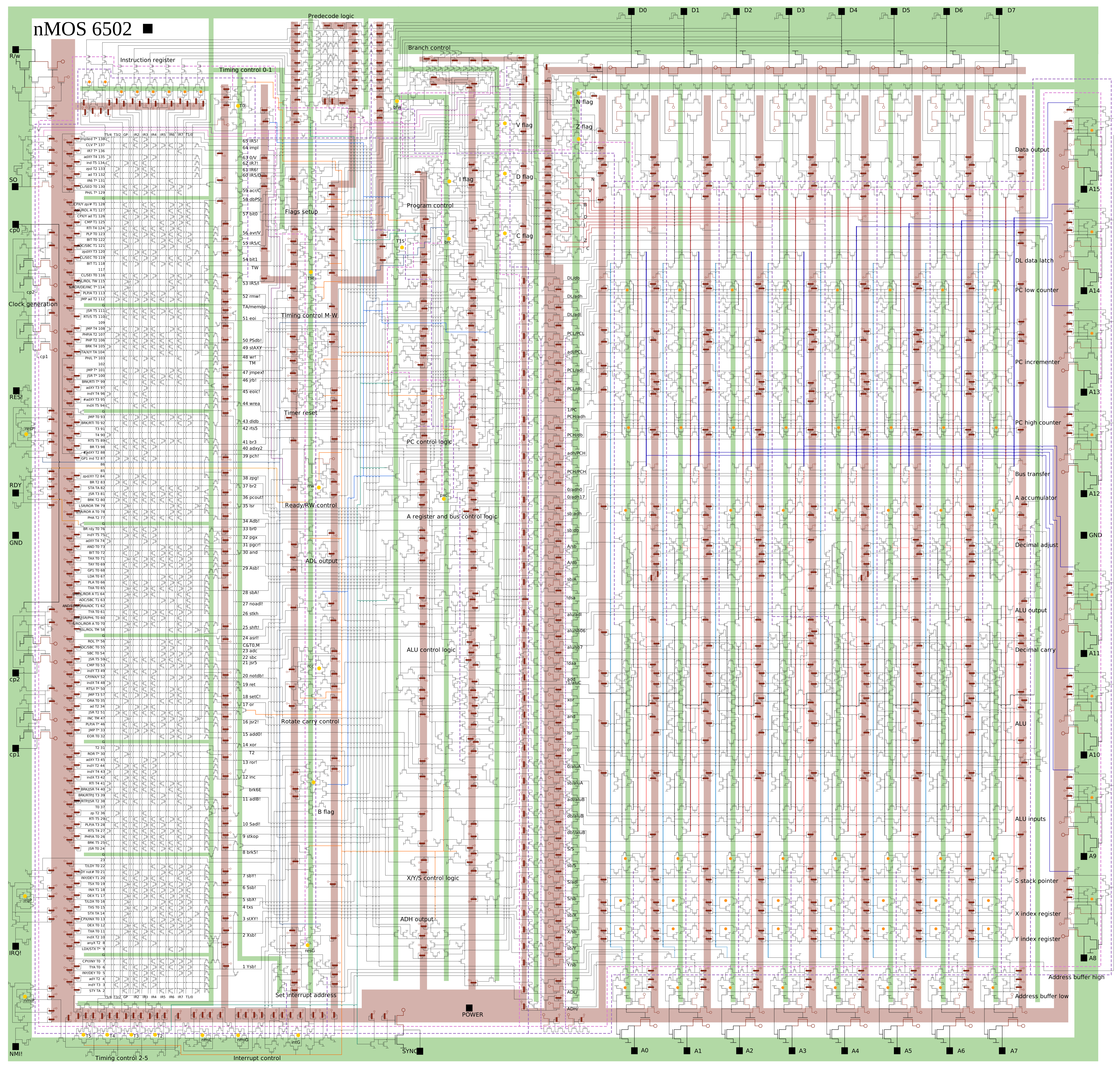
    This SVG (Scalable Vector Graphics) file is a representation of the 6502 at transistor level.
    The size of the transistors is intended to show drive strength, some
    bus driver pads having more milliamps of drive than other signals.

    https://davidmjc.github.io/6502/cd.svg

    ( https://davidmjc.github.io/6502/ )

    It you're the right kind of person, you'll now run off and make
    one of those out of transistors (and then we'll see a picture of
    your contraption on Tomshardware).

    That at least gives some idea how simple the things were inside,
    at least compared to the billions of transistor-equivalents in
    a CPU today.

    Paul
    --- Synchronet 3.21f-Linux NewsLink 1.2
  • From Daniel70@daniel47@nomail.afraid.org to alt.os.linux,alt.comp.os.windows-11 on Tue Mar 24 19:44:42 2026
    From Newsgroup: alt.os.linux

    On 24/03/2026 11:28 am, Paul wrote:
    On Mon, 3/23/2026 4:12 PM, ...w¡ñ§±¤ñ wrote:
    On 3/23/2026 2:12 AM, Daniel70 wrote:
    On 7/03/2026 5:51 am, rbowman wrote:

    <Snip>

    https://en.wikipedia.org/wiki/Z3_(computer)

    WOW!! 1938/41!! Who'd of thunk??

    I wonder if the little desktop Zuse (Apple 2 clone) that I used
    in 1983/4 might have been a great-great-grandchild of that big
    one??

    Maybe only in learning from the past.

    The Z3 was electrical relays, an Apple 2 clone 6502 processor
    transistor logic chips.

    This SVG (Scalable Vector Graphics) file is a representation of the
    6502 at transistor level. The size of the transistors is intended to
    show drive strength, some bus driver pads having more milliamps of
    drive than other signals.

    https://davidmjc.github.io/6502/cd.svg

    ( https://davidmjc.github.io/6502/ )

    It you're the right kind of person, you'll now run off and make one
    of those out of transistors (and then we'll see a picture of your
    contraption on Tomshardware).

    Well, the weather is turning cooler so I might need to create a bit of
    heat soon!! ;-P

    That at least gives some idea how simple the things were inside, at
    least compared to the billions of transistor-equivalents in a CPU
    today.
    --
    Daniel70
    --- Synchronet 3.21f-Linux NewsLink 1.2
  • From Carlos E.R.@robin_listas@es.invalid to alt.os.linux,alt.comp.os.windows-11 on Tue Mar 24 12:57:53 2026
    From Newsgroup: alt.os.linux

    On 2026-03-24 01:28, Paul wrote:
    On Mon, 3/23/2026 4:12 PM, ...w¡ñ§±¤ñ wrote:
    On 3/23/2026 2:12 AM, Daniel70 wrote:
    On 7/03/2026 5:51 am, rbowman wrote:
    On Fri, 6 Mar 2026 20:00:44 +1100, Daniel70 wrote:
    On 5/03/2026 11:33 pm, Jasen Betts wrote:
    On 2026-03-05, Daniel70 <daniel47@nomail.afraid.org> wrote:
    On 5/03/2026 7:25 am, Paul wrote:
    On Wed, 3/4/2026 6:12 AM, Daniel70 wrote:
    On 4/03/2026 8:24 pm, wasbit wrote:
    On 03/03/2026 12:52, Daniel70 wrote:
    snip < Thank you, Paul. I think I prefer HI (Human Intelligence) >>>>>>>>>>> rather than AI (Artificial Intelligence). ;-P

    AI stands for Artificial Insemination. You can't Artificial >>>>>>>>>> Intelligence a cow! :)

    AH!! Of course. Is that why people now speak of "LLM" instead?? >>>>>>>>
    They use LLM-AI to signify "this is not the final or real one". >>>>>>>>
    An AI that achieves Artificial General Intelligence (AGI) is the one >>>>>>>> that will join the "exclusive AI club".

    The first AI I ran into, was a port of ELIZA.

    https://en.wikipedia.org/wiki/ELIZA

    Initial release   1966

    1966?? You have GOT to be joking!! 1996, yeah, maybe, but 1966, No >>>>>>> Way!!

    '66? Sounds legit.

    There were computers before UNIX, and languages before C

    Oh, sure, there were computers back in WWII-times .... just I've never >>>>> considered them in more widespread than Defence-type usage.

    https://en.wikipedia.org/wiki/Z3_(computer)

    WOW!! 1938/41!! Who'd of thunk??

    I wonder if the little desktop Zuse (Apple 2 clone) that I used in 1983/4 might have been a great-great-grandchild of that big one??

    Maybe only in learning from the past.

    The Z3 was electrical relays, an Apple 2 clone 6502 processor transistor logic chips.


    This SVG (Scalable Vector Graphics) file is a representation of the 6502 at transistor level.
    The size of the transistors is intended to show drive strength, some
    bus driver pads having more milliamps of drive than other signals.

    https://davidmjc.github.io/6502/cd.svg

    Wow. Amazing. It doesn't look as having that many transistors, though?
    Those CPUS did not have many transistors. Chatgpt says 3510 aprox.


    ( https://davidmjc.github.io/6502/ )

    It you're the right kind of person, you'll now run off and make
    one of those out of transistors (and then we'll see a picture of
    your contraption on Tomshardware).

    That at least gives some idea how simple the things were inside,
    at least compared to the billions of transistor-equivalents in
    a CPU today.

    Yes, it looks as something that can be understood, manageable by a human.


    Paul
    --
    Cheers, Carlos.
    ES🇪🇸, EU🇪🇺;
    --- Synchronet 3.21f-Linux NewsLink 1.2