<https://www.cphysics.org/>
That page is written in HTML+CSS. I don't think it is hand written,
though. So it is almost a counter-proof to your theorem that HTML sucks.
With PDF, or other open formats,
Le 20-12-2025, Diego Garcia <dg@linux.rocks> a écrit :
With PDF, or other open formats,
Well, no. Once again you don't understand what you are claiming.
<https://www.cphysics.org/>
That page is written in HTML+CSS. I don't think it is hand written,
though. So it is almost a counter-proof to your theorem that HTML sucks.
That page is only a "container" that presents links for PDF documents.
It has to be written in HTML because that is the protocol for web servers.
But the actual content is delivered in the PDF format and that is the significant aspect.
Read his "style" page to discover his reasons:
<https://www.cphysics.org/style>
I would agree. Indeed, the majority of academic material is already distributed as PDF documents, using only an HTML "front page" to deliver
the links.
With PDF, or other open formats, there is no need for an author
to concern himself with the ridiculous task of accommodating
every possible viewport. This I have already stated.
For serious purposes, HTML *is* junk. It was spawned at a time when
PCs were very limited and could not present sophisticated audio/visual content in a sophisticated manner. In many ways that is still very true,
and that's why javascript and WebAssembly have been introduced. But
these tools are mere "shoehorns" that never should have happened and
would be totally unnecessary if Web content were distributed as open
source file formats.
But it seems that you are some sort of web developer and thus you
may may feel that your livelihood is threatened by such suggestions.
However, I must always maintain an objectivity and it is my assessment
that the Web would be much improved if information would be distributed
as open formats that could be downloaded and displayed on a users machine using local software rather than relying on HTML through a browser.
On 20 Dec 2025 16:24:47 GMT, Stéphane CARPENTIER wrote:
Le 20-12-2025, Diego Garcia <dg@linux.rocks> a écrit :
With PDF, or other open formats,
Well, no. Once again you don't understand what you are claiming.
I will not tolerate a total idiot like you defacing my claims.
Let me reiterate:
I am MASTER. You are LACKEY.
Do not ever attempt to overturn my infallible statements with
your wretched lunacy.
I make it as simple as I can,
in the same kind of "wall of text with a few embedded images" that was
the norm in 1995. No JavaScript, no PHP; if I need backend code, it is
a simple Perl script that generates simple, primitive HTML. I do not
even use CSS.
On the contrary, I am NOT a web developer, and I when I put up things on
the web, I do not care about formatting: I make it as simple as I can,
in the same kind of "wall of text with a few embedded images" that was
the norm in 1995. No JavaScript, no PHP; if I need backend code, it is
a simple Perl script that generates simple, primitive HTML. I do not
even use CSS.
On the contrary, I am NOT a web developer, and I when I put up
things on the web, I do not care about formatting: I make it as
simple as I can ...
Blasphemer! How DARE you present mere information, simply organized
and readily accessible?
On the contrary, I am NOT a web developer, and I when I put up things on
the web, I do not care about formatting: I make it as simple as I can,
in the same kind of "wall of text with a few embedded images" that was
the norm in 1995. No JavaScript, no PHP; if I need backend code, it is
a simple Perl script that generates simple, primitive HTML. I do not
even use CSS.
On 2025-12-20, Lars Poulsen <lars@beagle-ears.com> wrote:
On the contrary, I am NOT a web developer, and I when I put up things on
the web, I do not care about formatting: I make it as simple as I can,
in the same kind of "wall of text with a few embedded images" that was
the norm in 1995. No JavaScript, no PHP; if I need backend code, it is
a simple Perl script that generates simple, primitive HTML. I do not
even use CSS.
Blasphemer! How DARE you present mere information, simply organized
and readily accessible? You must present a User Experience full of
shiny gadgets and colourful text, lest the Web Police haul you away.
If I want to say update a database in real time without hitting a
'submit' button that is Ajax, JavaScript PHP and SQL.
On Sat, 20 Dec 2025 17:20:30 -0000 (UTC), Lars Poulsen wrote:
On the contrary, I am NOT a web developer, and I when I put up
things on the web, I do not care about formatting: I make it as
simple as I can ...
Come on, it’s not that hard to learn a little CSS to keep your layouts readable. The whole point about CSS was to separate form from content,
so that the same content could be repurposed to different rendering scenarios.
On 2025-12-21, Lawrence D’Oliveiro wrote:That is, to be fair, almost impossible
On Sat, 20 Dec 2025 17:20:30 -0000 (UTC), Lars Poulsen wrote:
On the contrary, I am NOT a web developer, and I when I put up
things on the web, I do not care about formatting: I make it as
simple as I can ...
Come on, it’s not that hard to learn a little CSS to keep your layouts
readable. The whole point about CSS was to separate form from content,
so that the same content could be repurposed to different rendering
scenarios.
Yet these days a lot of webdesign, including uses of CSS, centers around catering only to a few browsers or devices and trying to achieve equal
or similar design, instead of truly presenting content that gets
rendered based on the platform/browser/device which once was a major
point in the web.
I wish the web were a happier place. Fortunately there are still
readable sites out there. May be outranked in search engines promoting ad-ridden scrapped content sites whose ranking arises out of being chrome-for-android-friendly, but they do exist.
You specify a tiny font that will fit and the Apple browser defaults
to "minimum font size 11pt.
My personal feeling is that people are using the wrong technology
for the purpose
On 21/12/2025 11:27, Nuno Silva wrote:
On 2025-12-21, Lawrence D'Oliveiro wrote:That is, to be fair, almost impossible
On Sat, 20 Dec 2025 17:20:30 -0000 (UTC), Lars Poulsen wrote:
On the contrary, I am NOT a web developer, and I when I put up
things on the web, I do not care about formatting: I make it as
simple as I can ...
Come on, it's not that hard to learn a little CSS to keep your layouts
readable. The whole point about CSS was to separate form from content,
so that the same content could be repurposed to different rendering
scenarios.
Yet these days a lot of webdesign, including uses of CSS, centers around
catering only to a few browsers or devices and trying to achieve equal
or similar design, instead of truly presenting content that gets
rendered based on the platform/browser/device which once was a major
point in the web.
You specify a tiny font that will fit and the Apple browser defaults to "minimum font size 11pt.
On Sun, 21 Dec 2025 13:52:11 +0000, The Natural Philosopher wrote:
You specify a tiny font that will fit and the Apple browser defaults to
"minimum font size 11pt.
Apple’s Safari is not exactly a sterling example of web browsing done
right ...
On Sun, 21 Dec 2025 18:17:27 -0000 (UTC), Lawrence D’Oliveiro wrote:
On Sun, 21 Dec 2025 13:52:11 +0000, The Natural Philosopher wrote:
You specify a tiny font that will fit and the Apple browser defaults to
"minimum font size 11pt.
Apple’s Safari is not exactly a sterling example of web browsing done
right ...
The EU forced Apple to open up the field but prior to that any alternate browser had to use the Safari WebKit engine so they sucked as badly. I
don't know if that has had any practical effect.
That's perfectly reasonable in my book. I don't believe in
specifying exact fonts, sizes, etc. via CSS. Use <small> in plain
HTML if you want small text and the user can configure their
browser to display it in the way that works for them. Except where
some browser makers choose silly default behaviours for some
elements, plain HTML (4.0 Transitional) works to the user's best
advantage. I do most of my browsing with CSS turned off so all that
styling nonsense is ignored.
Whether it's things like hijacking or "papering over" links with CSS constructs that make it impossible to get to one page without going
through another page first and artificially boosting page views
thereby (looking at you, YouTube,) designing layouts that are
completely non- functional if assumptions about DPI/resolution
aren't met, requiring JS to display static page content, or any of a
dozen other common abuses ...
This is why browsers allow you to override site style definitions withYes, but it would be very much nicer if that wasn't *necessary.*
your own.
On Mon, 22 Dec 2025 22:27:19 -0000 (UTC)
Lawrence D’Oliveiro <ldo@nz.invalid> wrote:
This is why browsers allow you to override site style definitions
with your own.
Yes, but it would be very much nicer if that wasn't *necessary.*
Separation of form from content does *not* mean that web designers are obligated to use overwrought, kludgy, or abusive design patterns thatThis is why browsers allow you to override site style definitions
with your own.
Yes, but it would be very much nicer if that wasn't *necessary.*
On the contrary. This is an integral part of the whole concept of
separating form from content.
On Mon, 22 Dec 2025 23:12:32 -0000 (UTC)
Lawrence D’Oliveiro <ldo@nz.invalid> wrote:
This is why browsers allow you to override site style definitions
with your own.
Yes, but it would be very much nicer if that wasn't *necessary.*
On the contrary. This is an integral part of the whole concept of
separating form from content.
Separation of form from content does *not* mean that web designers
are obligated to use overwrought, kludgy, or abusive design patterns
that the user then has to direct their browser to ignore. That's an
absurd thing to say.
On Mon, 22 Dec 2025 15:37:25 -0800, John Ames wrote:
On Mon, 22 Dec 2025 23:12:32 -0000 (UTC)
Lawrence D’Oliveiro <ldo@nz.invalid> wrote:
This is why browsers allow you to override site style definitions
with your own.
Yes, but it would be very much nicer if that wasn't *necessary.*
On the contrary. This is an integral part of the whole concept of
separating form from content.
Separation of form from content does *not* mean that web designers
are obligated to use overwrought, kludgy, or abusive design patterns
that the user then has to direct their browser to ignore. That's an
absurd thing to say.
“Beauty lies in the eye of the beholder” would seem to be the most
polite response.
Beauty is in the eye of the beholder. Ugly goes to the bone.
You can argue that it's a matter of taste if you like. For myself, I am entirely comfortable saying that overwrought, kludgy, and (especially)Separation of form from content does *not* mean that web designers
are obligated to use overwrought, kludgy, or abusive design patterns
that the user then has to direct their browser to ignore. That's an
absurd thing to say.
“Beauty lies in the eye of the beholder” would seem to be the most
polite response.
For myself, I am entirely comfortable saying that overwrought,
kludgy, and (especially) abusive patterns are *objectively bad web
design,* in the same way that the people in charge of Grenfell Tower
were engaging in objectively bad architectural renovations ...
On Mon, 22 Dec 2025 23:45:56 -0000 (UTC)
Lawrence D’Oliveiro <ldo@nz.invalid> wrote:
Separation of form from content does *not* mean that web designers
are obligated to use overwrought, kludgy, or abusive design patterns
that the user then has to direct their browser to ignore. That's an
absurd thing to say.
“Beauty lies in the eye of the beholder” would seem to be the most
polite response.
You can argue that it's a matter of taste if you like. For myself, I am entirely comfortable saying that overwrought, kludgy, and (especially) abusive patterns are *objectively bad web design,* in the same way that
the people in charge of Grenfell Tower were engaging in objectively bad architectural renovations (thankfully, fewer people die as a result of
bad web design, most years,) and that web designers who employ them are
bad and should stop.
*A.* that's not what a straw-man argument is (that'd be if the behaviorFor myself, I am entirely comfortable saying that overwrought,
kludgy, and (especially) abusive patterns are *objectively bad web
design,* in the same way that the people in charge of Grenfell Tower
were engaging in objectively bad architectural renovations ...
Boy, what a way to escalate a strawman, conflating a matter of mere aesthetics and personal annoyance with a situation that was actually life-threatening on a massive scale.
On Tue, 23 Dec 2025 20:38:19 -0000 (UTC)
Lawrence D’Oliveiro <ldo@nz.invalid> wrote:
For myself, I am entirely comfortable saying that overwrought,
kludgy, and (especially) abusive patterns are *objectively bad web
design,* in the same way that the people in charge of Grenfell
Tower were engaging in objectively bad architectural renovations
...
Boy, what a way to escalate a strawman, conflating a matter of mere
aesthetics and personal annoyance with a situation that was
actually life-threatening on a massive scale.
*A.* that's not what a straw-man argument is ...
... Obviously, having trouble with a misbehaving website is a
smaller thing than burning to death in a badly-renovated apartment
building.
Arguing that web design is purely a matter of taste and objections to specific practices are Just, Like, Your Opinion, Man is, essentially,
arguing that the design and implementation of systems for use by the
general public is something where there are no real standards and no consequences to shoddy workmanship.
A straw-man argument is, to quote Wikipedia, "the informal fallacy of*A.* that's not what a straw-man argument is ...
... Obviously, having trouble with a misbehaving website is a
smaller thing than burning to death in a badly-renovated apartment building.
You say no, and then you say yes.
See, conflating opinions on aesthetics with issues of “workmanship” (quality of product) is another strawman.Both aesthetics and functionality have been points of discussion in
Obviously, having trouble with a misbehaving website is a smaller thing
than burning to death in a badly-renovated apartment building.* But
even in the little things - every pointless extra step, unneccessary
delay due to lazy, inefficient implementation, thing that has to be re-
done thanks to a buggy form, or irritating search for a feature buried
under baroque UI or incompatible CSS is seconds - minutes? hours? - off
of *someone's* life, maybe multiple someones', maybe *many people's.*
Obviously, having trouble with a misbehaving website is a smaller
thing than burning to death in a badly-renovated apartment
building.* But even in the little things - every pointless extra
step, unneccessary delay due to lazy, inefficient implementation,
thing that has to be re- done thanks to a buggy form, or irritating
search for a feature buried under baroque UI or incompatible CSS is
seconds - minutes? hours? - off of *someone's* life, maybe multiple someones', maybe *many people's.*
You make this sound like a bad thing. But it's merely the latest manifestation of something that's been around much longer than the
Internet. Consider the arrangement of products in a supermarket.
Sometimes there seems to be no rhyme or reason to it. I remember
when the local Safeway had spaghetti noodles in one aisle, and
spaghetti sauce in another. This kind of thing is often deliberate -
it keeps you wandering the aisles longer, making you more likely to
make impulse purchases, which translates to more sales, i.e. profits.
Cory Doctorow recently did a series of podcasts on "the
enshittification of the Internet". One example he mentioned was that
Google has started making their searches less useful and more
cumbersome, requiring you to make more mouse clicks to find what
you're looking for. Since their revenue is based on mouse clicks,
it's in their best interests to keep you pointing and clicking for as
long as possible before yielding up the answer to your inquiry.
* (And as Doctorow has brought up in his writing on "enshittification,"
it's often self-defeating in the long run - you win temporary gains,
but your thing is much worse and once someone comes along with a less
awful alternative, people will abandon you - and rightfully so.)
... "But Google isn't stupid!"
On Tue, 23 Dec 2025 22:48:55 GMT, Charlie Gibbs wrote:
... "But Google isn't stupid!"
See my comment elsewhere about how a company consisting of many
individually intelligent people can turn their work into collective stupidity.
On 22 Dec 2025 08:14:15 +1000
not@telling.you.invalid (Computer Nerd Kev) wrote:
That's perfectly reasonable in my book. I don't believe in
specifying exact fonts, sizes, etc. via CSS. Use <small> in plain
HTML if you want small text and the user can configure their
browser to display it in the way that works for them. Except where
some browser makers choose silly default behaviours for some
elements, plain HTML (4.0 Transitional) works to the user's best
advantage. I do most of my browsing with CSS turned off so all that
styling nonsense is ignored.
I do use some basic CSS for basic theming and layout, but overall I
agree that treating webpages as a medium for graphic design (not to
mention gimmicky JS navigation that all too often breaks standard browser-navigation conventions) is wrong-headed and counterproductive,
if not outright abusive. Unfortunately, "wrong-headed, counter-
productive, and abusive" is the name of the game in this year of our
Lord 2025 :/
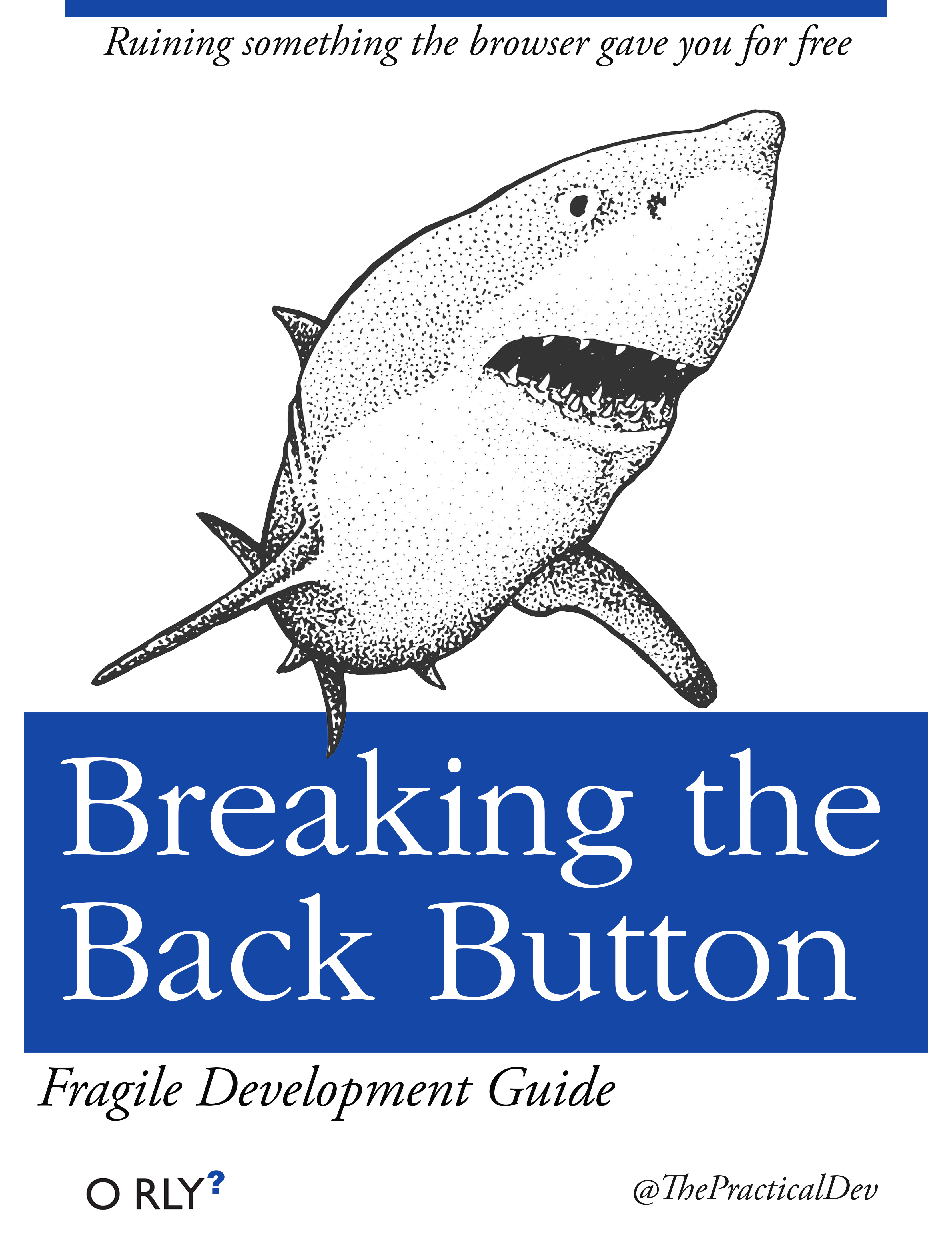
O'Reilly-style "Animal Book" cover, featuring a shark. On top has the)
text "Ruining something the browser gave you for free".The book title
reads "Breaking the Back Button: Fragile Development Guide" (Image by @ThePracticalDev, CC BY-NC 2.0, https://github.com/thepracticaldev/orly-full-res )
Whether it's things like hijacking or "papering over" links with CSS constructs that make it impossible to get to one page without going
through another page first and artificially boosting page views thereby (looking at you, YouTube,) designing layouts that are completely non- functional if assumptions about DPI/resolution aren't met, requiring JS
to display static page content, or any of a dozen other common abuses,
it's absolutely epidemic - and while I can keep my own little corner of
the Web tidy and sane, and I've seen an encouraging trend in that
direction among young hackers and hacker-adjacent blogosphere types,
there's only so far you can go without being exposed to some godawful bletcherous monstrosity of mainstream web design. It's enough to make
you long for Gopher...
On Mon, 22 Dec 2025 13:58:23 -0800, John Ames wrote:
Whether it's things like hijacking or "papering over" links with CSS
constructs that make it impossible to get to one page without going
through another page first and artificially boosting page views
thereby (looking at you, YouTube,) designing layouts that are
completely non- functional if assumptions about DPI/resolution
aren't met, requiring JS to display static page content, or any of a
dozen other common abuses ...
This is why browsers allow you to override site style definitions with
your own.
On Mon, 22 Dec 2025 14:43:14 -0800, John Ames wrote:
On Mon, 22 Dec 2025 22:27:19 -0000 (UTC)
Lawrence D’Oliveiro <ldo@nz.invalid> wrote:
This is why browsers allow you to override site style definitions
with your own.
Yes, but it would be very much nicer if that wasn't *necessary.*
On the contrary. This is an integral part of the whole concept of
separating form from content.
On Mon, 22 Dec 2025 15:37:25 -0800, John Ames wrote:
On Mon, 22 Dec 2025 23:12:32 -0000 (UTC)
Lawrence D’Oliveiro <ldo@nz.invalid> wrote:
This is why browsers allow you to override site style definitions
with your own.
Yes, but it would be very much nicer if that wasn't *necessary.*
On the contrary. This is an integral part of the whole concept of
separating form from content.
Separation of form from content does *not* mean that web designers
are obligated to use overwrought, kludgy, or abusive design patterns
that the user then has to direct their browser to ignore. That's an
absurd thing to say.
“Beauty lies in the eye of the beholder” would seem to be the most
polite response.
A straw-man argument is, to quote Wikipedia, "the informal fallacy of refuting an argument different from the one actually under discussion,
while not recognizing or acknowledging the distinction."
Whenever I start feeling too paranoid, I remind myself of Hanlon's
Razor: "Never ascribe to malice that which can be adequately be
explained by stupidity." But then a little voice in the back of
my head says, "But Google isn't stupid!"
I mean, it's*both* - a continuation of a long-established pattern
in our society*and* a bad thing. The fact that someone out there
excuses it as rational self-interest* (and may even be factually
correct) does not make it cool; abusive design patterns are bad, and
those who employ them knowingly are *bad people.* They should feel
ashamed of themselves and their mothers should all call to tell them
that they're very dis- appointed and had hoped they raised them
better than this.
* (And as Doctorow has brought up in his writing on
"enshittification," it's often self-defeating in the long run - you
win temporary gains, but your thing is much worse and once someone
comes along with a less awful alternative, people will abandon you -
and rightfully so.)
On 2025-12-23, John Ames <commodorejohn@gmail.com> wrote:
* (And as Doctorow has brought up in his writing on "enshittification,"
it's often self-defeating in the long run - you win temporary gains,
but your thing is much worse and once someone comes along with a less
awful alternative, people will abandon you - and rightfully so.)
Unless you manage to buy, bury, or sabotage the alternatives.
In that business, monopolies are the holy grail.
As a friend once remarked 'in business, everyone is looking for the
unfair advantage'
Am I supposed to be content with horrible design choices?
Anybody can criticize what experts do, not anybody can actually do
better.
Lawrence D’Oliveiro wrote:
Anybody can criticize what experts do, not anybody can actually do
better.
You think those are experts?
Lawrence D’Oliveiro wrote:
Anybody can criticize what experts do, not anybody can actually do
better.
You think those are experts? Experts in money and being cheap, I suppose,
but not experts in web development and design. Have you actually looked
into most javascript-riddled websites? A majority of the things they rely
on the client browser to generate could be done with basic HTML and maybe some CSS.
These web designers don't actually know what they are doing, they just know what everyone else is doing. This is evident by the amount of JS frameworks there are that make entirely simple things incredibly complex. If you actually know how to make websites, your job pays you not to.
It's a similar problem in the general software space. We used to have programs run as efficient as possible on little resources, but there are so many languages now that have power users that you'll find software made to
be as efficient as possible do an insane amount of processing at once but
it is made in python. Nobody knows what they're doing, they just know what everybody else is doing.
On Wed, 24 Dec 2025 20:01:55 -0600, kouya wrote:
Lawrence D’Oliveiro wrote:
Anybody can criticize what experts do, not anybody can actually do
better.
You think those are experts?
Feel free to show us how you can do a better job ... if you can.
Lawrence D’Oliveiro wrote:
On Wed, 24 Dec 2025 20:01:55 -0600, kouya wrote:
Lawrence D’Oliveiro wrote:
Anybody can criticize what experts do, not anybody can actually do
better.
You think those are experts?
Feel free to show us how you can do a better job ... if you can.
I don't know why you are so keen to see my own works ...
On Wed, 24 Dec 2025 21:34:18 -0600, kouya wrote:
Lawrence D’Oliveiro wrote:
On Wed, 24 Dec 2025 20:01:55 -0600, kouya wrote:
Lawrence D’Oliveiro wrote:
Anybody can criticize what experts do, not anybody can actually do
better.
You think those are experts?
Feel free to show us how you can do a better job ... if you can.
I don't know why you are so keen to see my own works ...
It’s called “put your money where your mouth is”.
Lawrence D’Oliveiro wrote:
On Wed, 24 Dec 2025 21:34:18 -0600, kouya wrote:
Lawrence D’Oliveiro wrote:
On Wed, 24 Dec 2025 20:01:55 -0600, kouya wrote:
Lawrence D’Oliveiro wrote:
Anybody can criticize what experts do, not anybody can actually do >>>>>> better.
You think those are experts?
Feel free to show us how you can do a better job ... if you can.
I don't know why you are so keen to see my own works ...
It’s called “put your money where your mouth is”.
Maybe in a case where it would call for it but we're talking about
designing things based on a static logic.
Keep spouting your empty, vacuous rationalizations, why don’t you.
Lawrence D’Oliveiro wrote:
On Wed, 24 Dec 2025 21:34:18 -0600, kouya wrote:
Lawrence D’Oliveiro wrote:
On Wed, 24 Dec 2025 20:01:55 -0600, kouya wrote:
Lawrence D’Oliveiro wrote:
Anybody can criticize what experts do, not anybody can actually
do better.
You think those are experts?
Feel free to show us how you can do a better job ... if you can.
I don't know why you are so keen to see my own works ...
It’s called “put your money where your mouth is”.
Maybe in a case where it would call for it but we're talking about
designing things based on a static logic. It should be plenty enough
if you understand the subject but you clearly don't.
It's not "put your money where your mouth is" here, it's "show me
your crap so I can insult it for not fitting my argument". Even if I
wasn't under NDA, all your responses have been bad faith. You haven't
truly engaged with anybody and gave a genuine argument of your own
that shows you have the slightest clue on the topic. How about you
show me you know a damn what you're talking about?
Lawrence D’Oliveiro wrote:
Keep spouting your empty, vacuous rationalizations, why don’t you.
PLONK!
| Sysop: | DaiTengu |
|---|---|
| Location: | Appleton, WI |
| Users: | 1,090 |
| Nodes: | 10 (0 / 10) |
| Uptime: | 64:53:41 |
| Calls: | 13,949 |
| Calls today: | 2 |
| Files: | 187,035 |
| D/L today: |
4,674 files (1,402M bytes) |
| Messages: | 2,461,444 |