From Newsgroup: comp.mobile.android
David Woolley wrote:
On 27/04/2026 22:49, Maria Sophia wrote:
Mathematically, if you charge your phone once a day,
I think that should read: if you charge your phone from the point where
it has powered down, to avoid over discharge, until the 100% level,
exactly once a day.
I believe that charging from say 30% to 80% would count as half a cycle,
and may actually be equivalent to less than that, in terms of wear on
the battery.
I've got a Samsung A16, which has been charged from about 55 to 60%, up
to 80%, once a day for about a year and a half. The statistics
(Settings | Battery | Battery Information) say the cycle count is 135,
which is not that inconsistent, given that the above figures are approximate. It's quoting a battery health figure of 98%. I assume
that is the same figure as the 80% figure in the standards. I don't
know if it represents an attempt to measure the actual capacity, or is simply: 100 - (equivalent cycles / 1000) * (100 - 80).
If a partial cycle counted as a whole cycle, I'd expect a cycle count of over 500 and a health of a little under 90%. Also remember that there
can be short cycles whilst connected to the charger, if power used, plus losses, exceeds power input, which if counted as full cycles, would drastically affect the the total cycle count. All in all, I think you
would need a level of use which is almost exactly that which can only
be sustained for one day, less the time connected to the charger. I'd suggest that many people would be aiming to have a significant amount of capacity left, at the end of the day.
Hi David,
Thank you for your well thought out commentary as it shows you're thinking about this in exactly the right way given we're making sense of the data.
I appreciate you thinking about this in a sound manner as you deserve a
serious response to your apropos observations, which I agree with. I'd
never disagree with any logically defensible position, which yours is, especially as this kind of discussion is perhaps unique on the Internet.
The UE/UK know that battery life is likely the primary reason phones become electronic waste. Hence, keeping track of battery-health metrics is vital.
There are plenty of utilities that help us keep track of battery
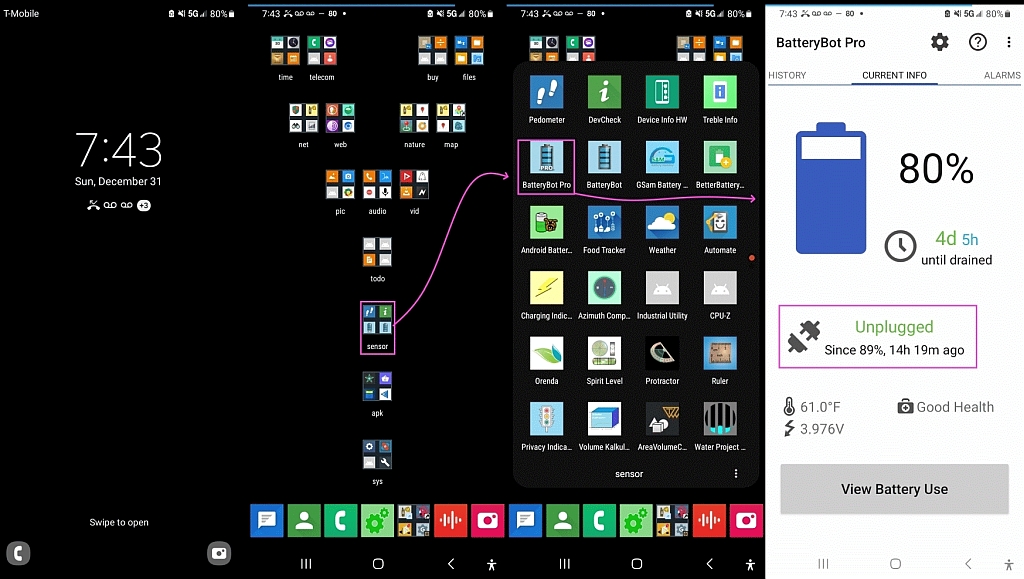
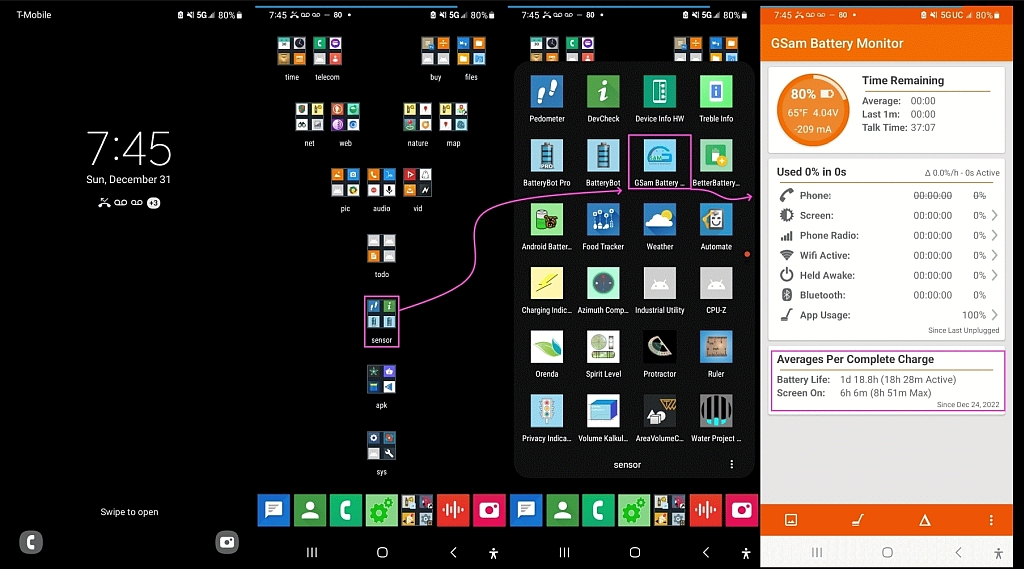
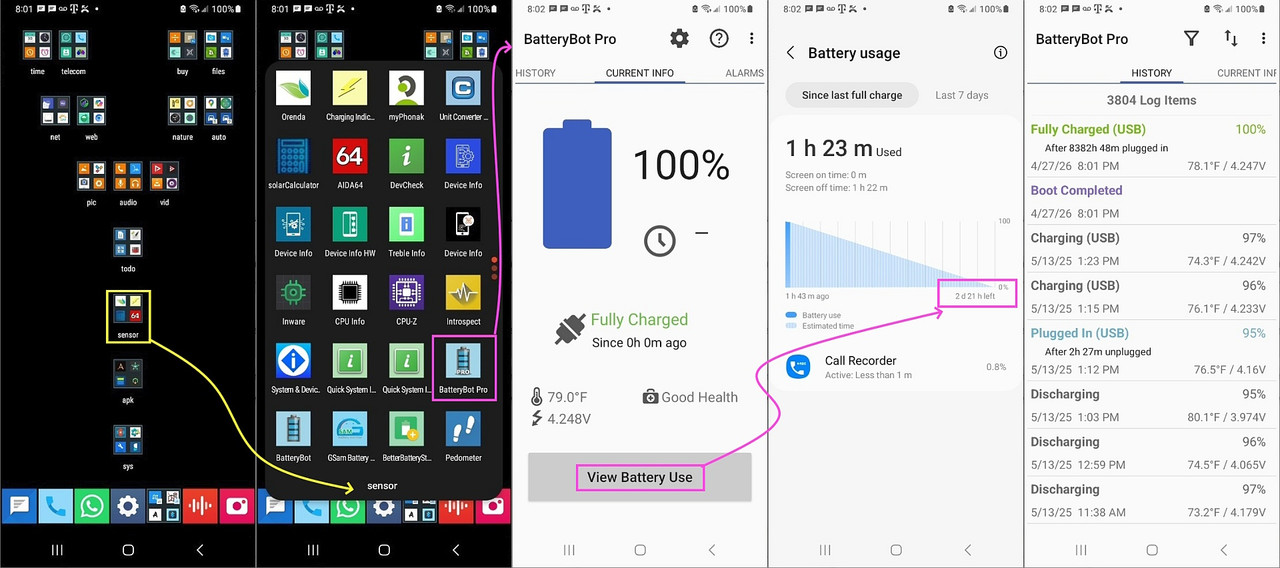
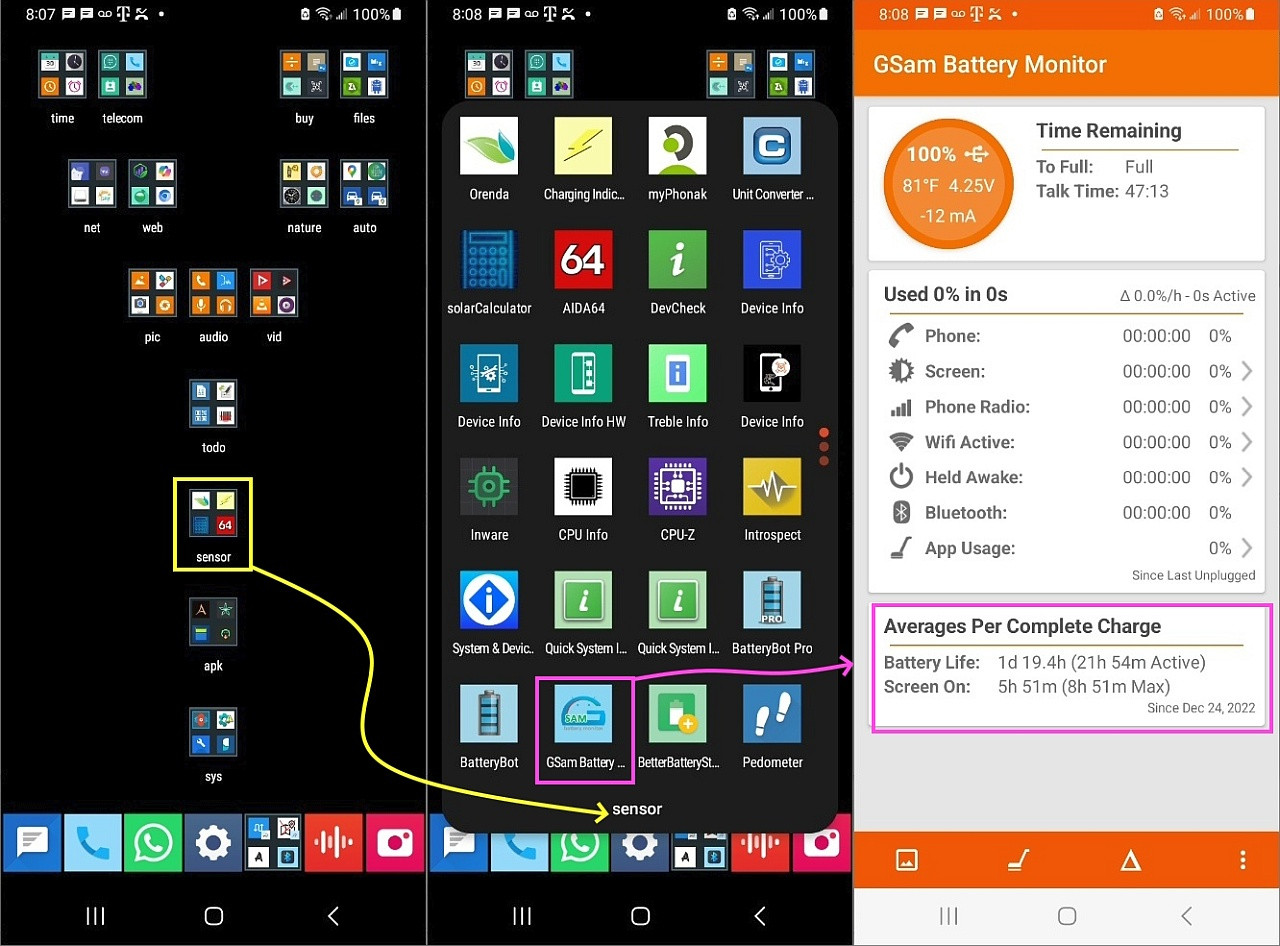
health, where, just by way of example, here are my own screenshots: <
https://i.postimg.cc/k5X8Ccpx/batterylife01.jpg> (Battery Bot 2023) <
https://i.postimg.cc/sxRgjfgt/batterylife02.jpg> (GSam 2023) <
https://i.postimg.cc/NfzbxFrq/batterylife03.jpg> (Battery Bot 2026) <
https://i.postimg.cc/nrd2gcRH/batterylife04.jpg> (GSam 2026)
I agree that we almost never wait for a battery to hit 0%. My own
phone (an el-cheapo, actually free) Galaxy A32-5G from 2021 with a stock
5AH battery currently shows 2 days and 21 hours of charge remaining.
As you can see, my GSam averages since Dec 24, 2022, show an average
of 1 day 19 hours of battery life with 5h 51m of avg screen-on time.
Why would I charge my phone nightly when it lasts for almost 2 days?
I charge it when it needs it, where fast chargers take only a few hours.
As for the physics of cumulative lithium-ion wear being cumulative,
you are completely correct, where, as you noted with your A16 (135 cycles
over 18 months), staying in that 20-80% Goldilocks zone is far gentler than full 0-to-100% swings. You didn't mention the charger, but slow charging,
while it takes longer, also should improve the life of the battery.
None of that was discussed in my prior purely EU/UK based calculations.
However, it's important to be clear that the kill-time math I proposed
actually incorporates your logic automatically as it moves us past the
"one charge per day" guesswork by using the EU-standardized Daily Cycle
Ratio (24h / Endurance).
1. Your A16 stats prove the math, where your ~0.24 cycles/day wear rate
is exactly what happens when a phone's endurance exceeds the user's
daily needs. You aren't spending a full cycle every 24 hours because
your battery capacity & endurance is capacious enough to not need it.
2. Regarding the kill-time calculation, it accounts for partial cycles
where, using the EU Endurance Rating (standardized laboratory loads),
we see how much of a "cycle" is consumed in a standard 24-hour day:
a. iPhone 17 Pro Max: 53h endurance = 0.4528 cycles/day
b. Galaxy S26 Ultra: 55h endurance = 0.4363 cycles/day
3. The reason the Samsung wins, despite Apple's (admittedly brilliant)
"efficiency" claims, can be termed the bank-account effect.
Even if one of us owned the iPhone and the other the Samsung,
and even if we practiced perfect battery hygiene like you do,
the Samsung user still wins because they are:
a. Consuming a smaller fraction of a cycle per day (better efficiency)
b. Drawing from a larger bank account of rated cycles (1,200 vs 1,000)
Note that the S26 Ultra is using higher-density silicon-carbon chemistry to
hit that 1,200-cycle mark, while Apple chose to use far cheaper components.
So what's the bottom line using the EU/UK legally mandated figures?
Well, I ask others, as always, to check my facts and my math, but given
total cycles / daily cycle drain = life in days
a. iPhone 17 Pro Max 1,000 / 0.4528 = ~2,208 days (~6.05 Years)
b. Galaxy S26 Ultra 1,200 / 0.4363 = ~2,750 days (~7.53 Years)
If you ask me, a reasonable assessment is that the UK/EU has finally
exposed that Apple's (admittedly brilliant) "efficiency" marketing does
not result in a longer-lasting device in this flagship-model comparison.
Samsung provides ~542 extra days (about 1.48 years) of extra usable health.
In summary, you're right that practicing good battery hygiene helps, but no amount of careful charging can bridge a 24.5% hardware gap in chemistry.
--
On Usenet, wizened old men discuss topics of interest, where each adds
their own flavor of value so that the group, as a whole, benefits greatly.
--- Synchronet 3.21f-Linux NewsLink 1.2